


「」Plaza: Frame and Loop
2026 13th X-site Competition (Taipei Fine Arts Museum Plaza)
2025
Team: Physis Studio
(Shao-lun CHIU, Yu-Lin HSIAO, Rhui-Hen HSIEH, Hong-Yi LIN, Jovan Chen)
「 」 Plaza: Frame and Loop,” reimagines the plaza in front of TFAM by treating the site itself as an artwork through a new interpretation of boundaries. Rather than inserting a single object, the design shifts toward a holistic reading of the entire plaza. Since the area is typically a passageway for visitors heading to the museum, café, or Expo Park, the intervention introduces a light, spatial interface to clearly define the field. Once the boundary is established, the plaza gains a renewed identity.
Existing architectural elements and sculptures are regarded as anchoring points, while the temporary installation uses a precise rectangular framework to establish a readable spatial order. Acting like an instrument for measuring experience, the structure gently touches the ground and connects the site through flows of people, wind, light, shadow, and sound. These interactions generate natural paths and loops, opening up new possibilities for activities and engagement within the plaza.

sketch by Yu-Lin, HSIAO

「 」 Plaza portrays the relationships among humans, nature, and site. Rather than treating nature as a static object or a quantifiable discipline, nor reducing humans to mere productive machines, the focus lies in allowing generative relationships to emerge within the plaza.
In the temporary installation craquelures dans le réel for Lausanne Jardins 24, the approach was to respond to the city’s ground through plowing and irrigation—not by adding another layer of artificial greenery atop asphalt, but by creating fissures in the hardened surface and introducing moisture, giving life the chance to sprout in the most unlikely places. This method does not stage nature; instead, it loosens control and creates conditions for nature to appear at its own pace.
A scene from the film White Plastic Sky depicts humans and plants forcibly merged, becoming “plant-humans” connected to mechanical tubing. The discomfort of that image reminds us that once nature is fully technologized, humans too become objectified. Yet when the sky dome opens and light and mist cascade from above, the body is suddenly absorbed into a larger cycle—we are no longer simply part of a machine, but becoming part of nature itself.
From installation to film, both share a shift: humans move from the position of “controlled/maintainers” to “co-performers/caregivers,” and the site shifts from a “disciplined container” to a “generative relationship.” This understanding becomes our starting point: rather than importing nature into the plaza, we open a boundary and allow nature to generate itself.

sketch by Yu-Lin, HSIAO

craquelures dans le réel, Lausanne Jardins 24
The project draws its prototype from modular agricultural greenhouses, which adapt easily to fields, rooftops, and interior spaces. While museums protect artworks through controlled air-conditioning, greenhouses safeguard crops through adjustable light, wind, and water. This installation creates a sensory interface between these two environmental systems.
The Plaza opens the closed box by proposing a breathable boundary. Using a deconstructed greenhouse vocabulary—frames, ellipses, mesh, and mist—the installation lets wind pass, rain fall, and light trace shifting patterns on the ground.
In Greek, nature (phýsis) refers not to static objects but to a process of self-generation. With this understanding, the TFAM plaza becomes a site that can “generate.” Here, people may be observed or become performers; they may be cared for by the climate or enter natural cycles themselves. This dynamic boundary opens the city and activates the plaza.
As rain forms mirrored surfaces on serpentine stone, wind moves the mesh, and the rhythms of dancers and passersby intersect, the plaza becomes a generative performance where people, architecture, and climate unfold together.


sketch by Yu-Lin, HSIAO
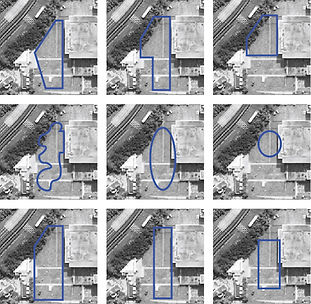
We conceive 「 」 as a boundary that can be read. When everyday walks, fashion shows, and dance performances take place, can the order formed by rectangles, circles, ellipses, and free geometries act as cues for behavior? Through different interfaces, the project explores how interactions among people, nature, and the plaza can be guided, allowing visitors not merely to experience a single object but to naturally become performers within the plaza.
diagram by Shao-Lun, CHIU


The boundary itself operates as a machine of experience. The installation establishes rhythms and rules through which the public nature of the site can operate on its own.
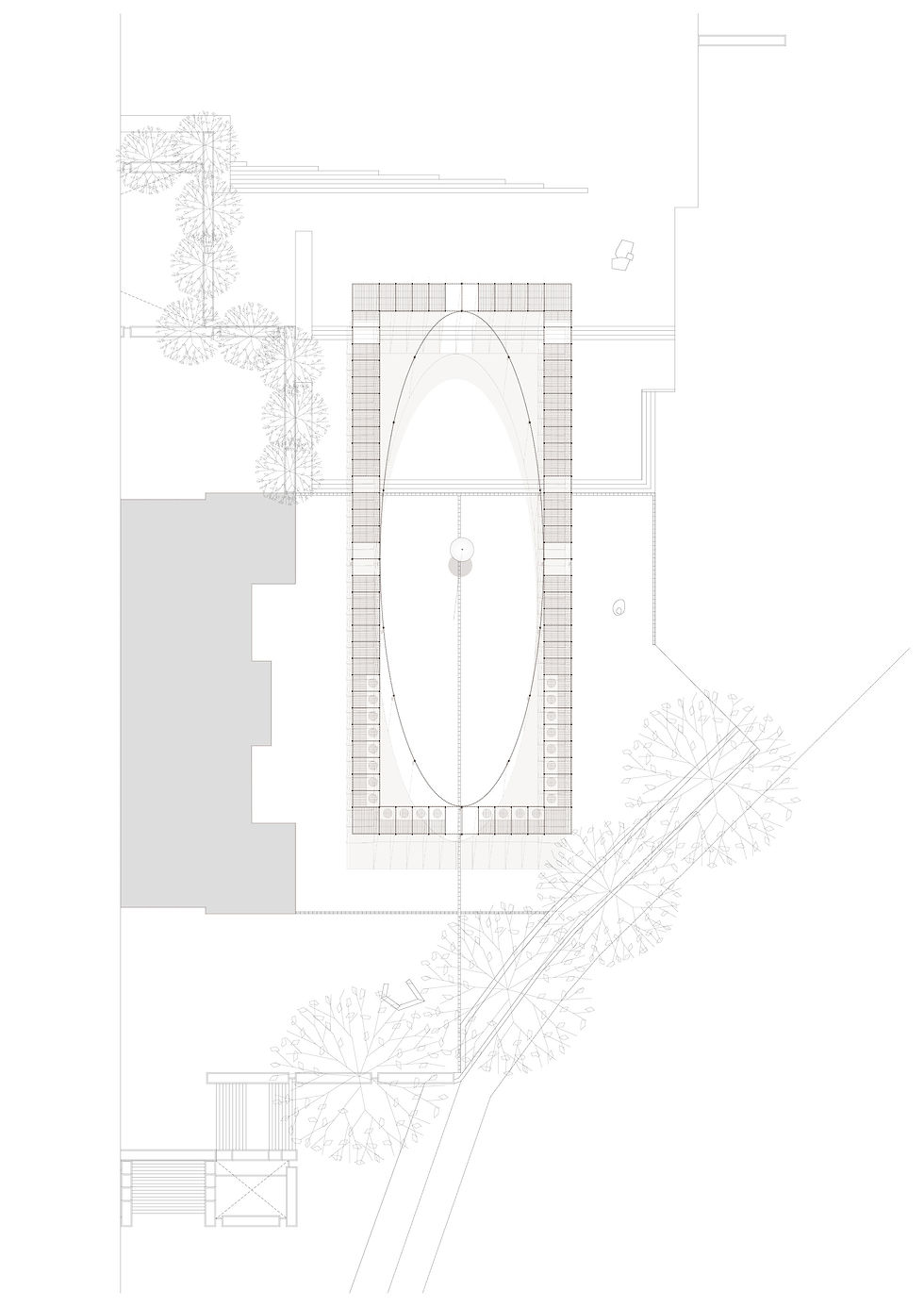

plan by Rhui-Hen, HSIEH

The nighttime lighting strategy extends the daytime concept of fluidity and uncertainty, avoiding the use of strong illumination to define boundaries. Low–color-temperature LED strip lights are installed beneath the wooden platforms, providing only minimal guidance for safe movement. This maintains a soft ground-level glow, allowing people to move freely between light and shadow.
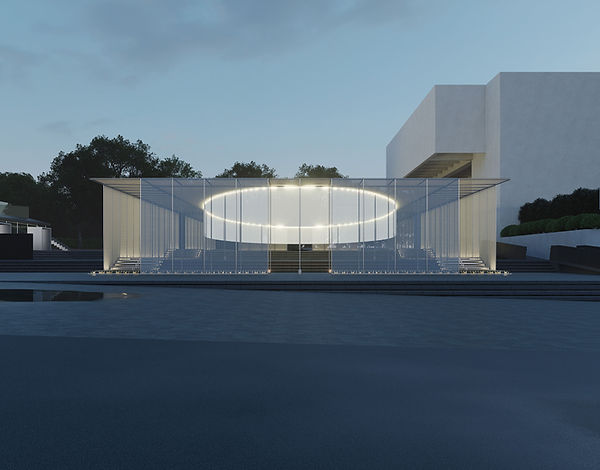


section by Rhui-Hen, HSIEH